
…to say she had 27 Lady Slippers in her yard. The most ever. Yay for wild orchids in Maine!


McGuinness boys: Bill takes some shots while Finn hangs out inside.
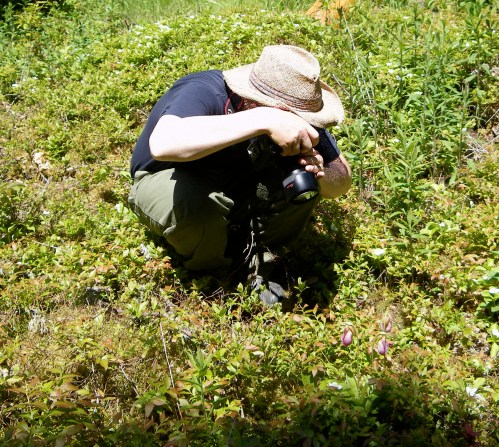


…to say she had 27 Lady Slippers in her yard. The most ever. Yay for wild orchids in Maine!
McGuinness boys: Bill takes some shots while Finn hangs out inside.
Filed under Uncategorized
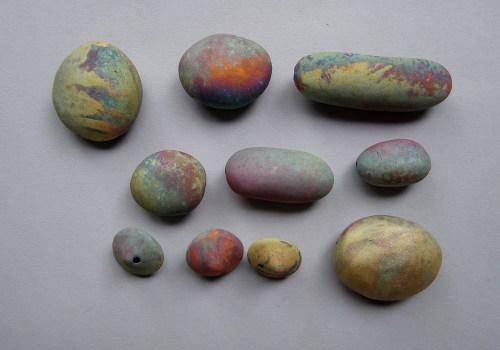
Some of these pieces are all bronze and some all copper. But a few were made of a “marbled” copper bronze blend. I love the colors just after firing. Holly, you were right. More color seems to show up after the charcoal has been used for several firings.

I don’t mind a matte finish for earring parts, but I want the beads I wear against my skin to feel smooth. I put this load in the tumbler with steel shot to see what would happen to the surface and the color. Result: More shine, less color.

The “rock” beads looked like actual rocks, right out of the kiln. After being tumbled for 15 minutes, they looked like rocks with jaundice. (Not quite the look I was hoping for!)
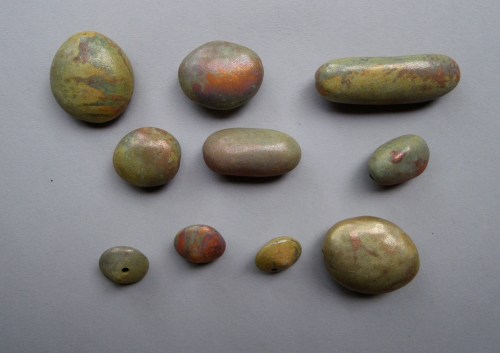
To test how much of the color on these beads was from the marbled effect of the mixed clays, I used the buffing wheel and Fabuluster compound to achieve a high polish on the bronze beads. Then I used Baldwin’s Patina to see how much of the copper would oxidize.

I’m not satisfied with how they came out. The last test on these beads will be to polish off the patina and bury them in the hot activated charcoal the next time I fire my kiln. Maybe I can recreate some of the color that came out of the kiln originally, while maintaining the smoother surface. I tried to do this with a torch, but the results were unremarkable.
Filed under Uncategorized
I finally got some Baldwin’s Patina to try on my pieces of mixed bronze and copper clay. I learned about it from Hadar’s blog, and was happy to see that Rio Grande carried it. It makes quite a difference. The copper turns to a rich color that contrasts better with the bronze. I wish it did not color the bronze at all, but it does, slightly.
The piece on the left has been oxidized with Baldwin’s Patina.
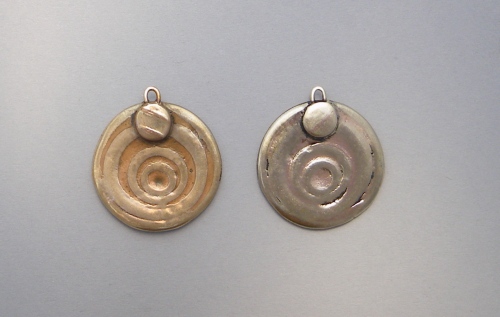
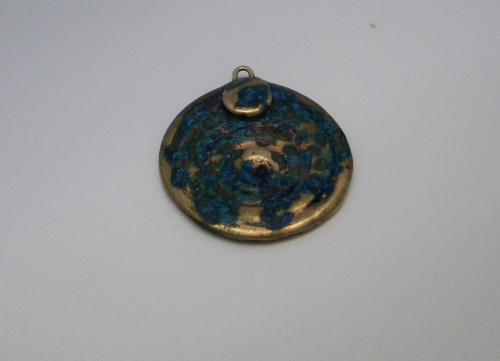
To try another patina, I took the untreated piece on the right and suspended it in a sealable container over a shallow layer of ammonia with a little vinegar added. I then sprinkled the piece with salt. I left it covered for about 6 hours. Love the color! There seemed to be no difference in how it colored the bronze or copper. I will definitely try this again, in a more controlled way. (I wonder if there could be any kind of “resist” used to control where the blue color goes.) I also applied Renaissance Wax to this to see if it affected the color. It didn’t seem to change it much. Below is the piece, with the Renaissance Wax applied.
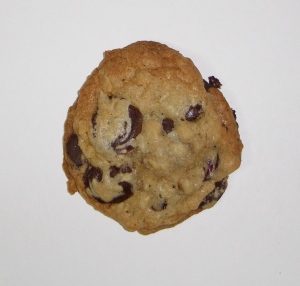
Next, I took another piece and tried a mixture of oatmeal, cranberry, and chocolate, and applied heat for about 10 minutes.
Filed under Uncategorized
“Mama said there’d be days like this…”
It was just one of those frustrating days in the studio. Several of the pieces of copper clay I was finishing (sanding), before firing, broke when I was almost done…. AFTER I’d put the time into sanding down the inlayed copper or brass clay. It may have been a “dumb day” but I learned something from it. I am rolling the copper and bronze clay too thin. This happens the most with pieces I want to inlay.
After all the time spent with silver PMC+, I have learned to make pieces fairly thin to cut down on the cost of material. I’ve gotten pretty good at making beads that are 2 cards thick, still having enough thickness to prefinish the piece, with those spongy 3M sanding pads, before firing. This ends up being too thin, for me, with copper or bronze clay.
I’ve rolled out copper and bronze clay to 4 cards thick, then stamped or pressed stuff into it to make a depression for clay inlay. The depression ends up being only about 2 cards thick. It does not take the stress of my handling it, before it is fired. The pieces keep breaking before I get to fire them. This happens more with flat pieces than hollow forms.
After breakage, I fire the pieces anyway, so they can used as test pieces. I have so much to learn about this base metal clay!
Filed under Uncategorized

I like to test my new designs by wearing them for a while. How does the weight of the piece feel? How does it sit on my neck or on my ears? And in the case of my new bronze and copper clay beads, how quickly do they oxidize (tarnish) when worn against the skin, or when left out by the sink in the bathroom or wherever I have taken them off and laid them down. (I’m not real careful with my own jewelry, which can end up being a form of quality control.)
This 16″ knotted necklace of silver, copper and bronze flat beads is one I have been wearing all weekend. The silver beads are fine silver (99.9% pure silver), so they do not oxidize as quickly as sterling silver, because they do not contain any copper. Copper?! Were my buffed-to-a-shine copper beads starting to darken a little? And their bronze sisters, an alloy of copper and tin, were they starting to lose their golden glow? Hmmm, would my skin turn green under the copper beads if I started to perspire? (While it’s not hot yet in Maine, it is almost summer…) I need to wear this prototype for a while longer to answer my questions.

I also want to test something else. I applied Renaissance Wax to the beads on one side of the necklace to see if it will keep them from oxidizing so quickly. I’ve read of using Renaissance Wax on jewelry to preserve a patina. I’ve used a similar wax (Butcher’s Wax) to protect and preserve specifically oxidized areas on a silver piece. The Renaissance label reads, “Refined waxes blended to a formula used by the British Museum and restoration specialists internationally to revive and protect valuable furniture, leather, paintings, metals, marble, ivory and many other surfaces both housed and exposed to weather.” (Sounds like a multi-tasker!)
Not only am I testing the wax for preventing oxidation on the copper and bronze, I want to know what will happen to my skin when exposed to the waxed surface of the beads for hours at a time. Stay tuned. I hope the wax does everything I want it to do, and nothing I don’t want it to do!

Filed under Uncategorized

Since it’s hard to come up with a jewelry related photo every day……
Filed under Uncategorized
Stringing area before and after:


The collage, resin, and paperwork area gets tidied up:


Filed under Uncategorized
The more time I spend in the studio the messier it gets. Here’s a glimpse of my work space and sign of how much time I have spent working with bronze and copper clay in the last few days:

Fellow jeweler, (and my son’s girlfriend) Meghan Quinn is coming for the weekend, and I want her to try some bronze and copper clay. My studio is small, about 10′ by 10′. Finding room for a second person to work with me was a great incentive to clean up the mess and reorganize.

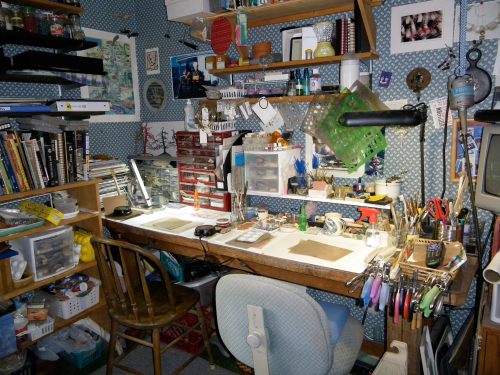
Part two will be the other work areas in my studio. I just don’t have those “after” photos to post yet…
Filed under Uncategorized
…during dinner Friday night at the Dudman’s home on Islesford.
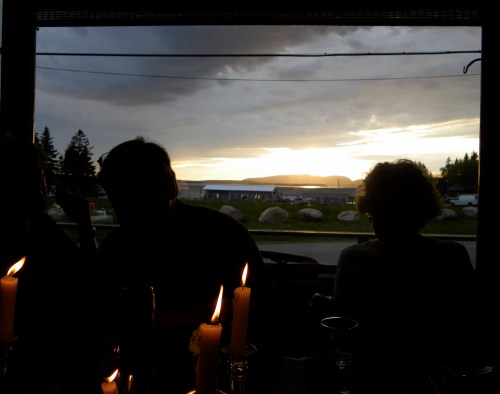
While at home the bread dough had more time to rise than it needed…

I punched it down and shaped 4 loaves. They rose so quickly, I cut each loaf in half.

8 loaves of tomato cheese bread for the Islesford Library bake sale on Saturday. Memorial Day weekend begins.
Filed under Uncategorized
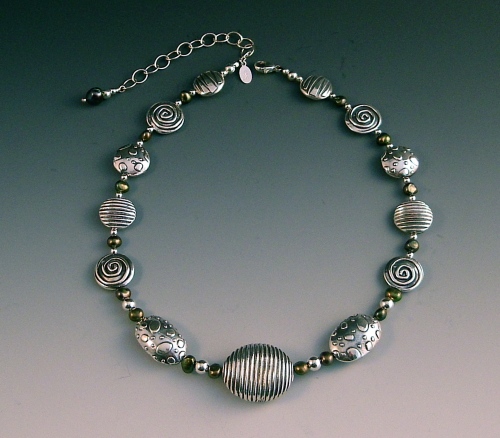
Fine silver PMC and freshwater pearls.
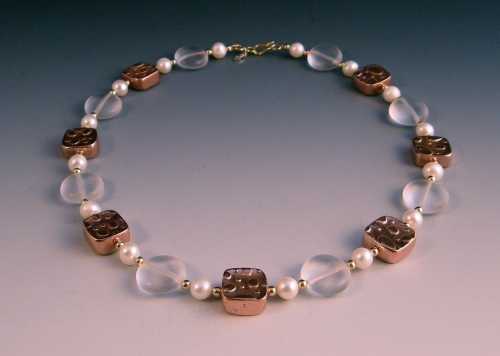
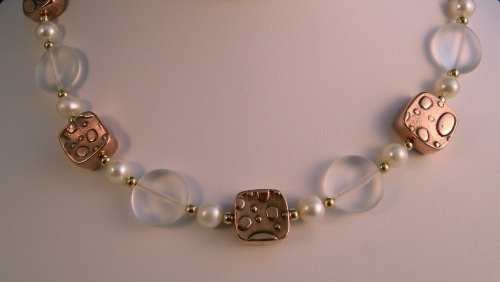
Copper clay beads with glass, f.w. pearls, gold filled beads.
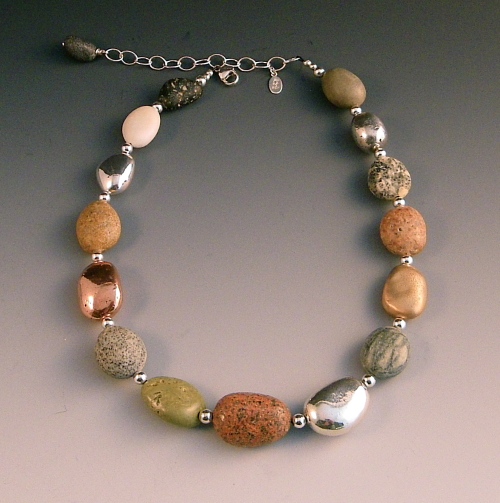
Islesford beach stones with “stone” beads of silver, bronze and copper metal clay.
Filed under Uncategorized
 Barbara S Fernald Jewelry